AI is changing how people find businesses. Instead of scrolling through pages of search results, customers now ask ChatGPT, Gemini, and Google’s AI Overviews for recommendations. If your business shows up in those answers, you win attention before your competitors even get a look. But here is the tricky part: how do you actually measure whether that visibility is making you money?
That question keeps a lot of business owners up at night. You can see your brand mentioned by an AI tool and feel great about it, but feeling good is not the same as knowing your return on investment. As a trusted SEO agency in Toronto, Pat’s Marketing helps local businesses turn AI visibility from a vanity metric into a revenue driver you can actually track. Let’s walk through how to do exactly that.
What AI Visibility Really Means?
AI visibility is how often and how prominently your business appears in AI-generated answers. When someone asks an AI assistant, “Who is the best plumber near me?” or “What is a reliable marketing agency in my city?”, the tools pull from web content, reviews, and structured data to build a response.
Your goal is to be part of that response. But being mentioned is only step one. The real work is connecting that mention to leads, sales, and profit.
Did You Know? AI-driven search referrals are growing fast, and many businesses see traffic from AI tools before they even realize it is happening. Checking your analytics for referral sources like ChatGPT or Perplexity can reveal traffic you did not know you had.
Why Measuring AI Visibility ROI Is Different?
Traditional SEO gives you clear numbers. You can see keyword rankings, clicks, and conversions in a straight line. AI visibility is fuzzier because the “search” happens inside a chatbot, and the user may never click a link at all.
That does not mean it is unmeasurable. It just means you need a smarter approach that blends a few different signals together.
Here are the main challenges you will face:
- AI tools do not always send referral data the way Google does.
- A customer might discover you through AI, then search your brand name later.
- The buying journey often spans several touchpoints before a sale.
The solution is to build a measurement system that captures the full picture rather than obsessing over one number.
Step-by-Step: How to Calculate AI Visibility ROI
Let’s get practical. Here is a clear framework you can follow to tie AI visibility to real revenue.
1. Set Your Baseline
Before you can measure growth, you need a starting point. Record your current numbers for the metrics that matter:
- Website traffic from AI referral sources
- Branded search volume (people searching your business name)
- Total leads and their sources
- Revenue from new customers
Write these down. Without a baseline, any improvement is just a guess.
2. Track AI Referral Traffic
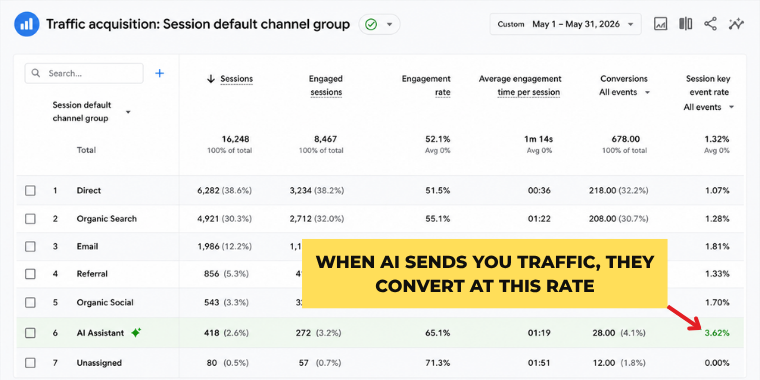
Dig into your analytics and filter for referral sources tied to AI platforms. Look for traffic coming from tools like ChatGPT, Perplexity, Gemini, and Copilot. Tag this traffic so you can watch it over time.
3. Monitor Branded Search Lift
When people hear about you through an AI answer, many will later type your name into Google. A rise in branded searches often signals that your AI visibility is working, even when direct referrals are hard to trace.
Quick Tip: Compare your branded search volume before and after you start optimizing for AI visibility. A steady climb is a strong sign that AI mentions are feeding your funnel.
4. Connect Visibility to Conversions
This is where the money math happens. For every lead, ask how they found you. Add a simple “How did you hear about us?” field to your contact forms and intake calls. Over time, patterns emerge that show which AI touchpoints drive real business.
5. Calculate the Return
Now put the numbers together. The basic ROI formula looks like this:
- Add up the revenue generated from AI-influenced leads.
- Subtract the cost of your AI visibility efforts.
- Divide that result by your cost.
- Multiply by 100 to get your ROI percentage.
If you spent $2,000 on optimization and it produced $10,000 in new revenue, your ROI is 400 percent. That is the kind of number a good SEO agency in Toronto helps you reach and prove.
Important: ROI takes time to build. AI visibility is a compounding asset, not an overnight switch. Give your strategy a few months before you judge the results, and track trends rather than single weeks.
Metrics That Actually Matter
Not every number deserves your attention. Focus on the ones that connect to revenue instead of the ones that just look nice.
Metrics Worth Tracking
- Qualified leads from AI sources: Real potential customers, not just clicks.
- Conversion rate of AI-referred visitors: Are they buying or bouncing?
- Customer lifetime value: How much a new customer is worth over time.
- Cost per acquisition: What you spend to win each customer.
Metrics to Ignore
- Raw mention counts with no context
- Impressions that never lead to action
- Follower numbers that do not translate to sales
The difference between these two lists is the difference between guessing and knowing.
How Local Businesses Win With AI Visibility?
If you run a local business, AI visibility can be a game changer. Customers in your area are asking AI tools for recommendations every single day, and the businesses that show up in those answers capture demand at the exact moment it forms.
To improve your standing, focus on:
- Strong, consistent business listings across the web
- Genuine customer reviews that build trust
- Clear, structured website content that AI tools can understand
- Local keywords woven naturally into your pages
A skilled SEO agency in Toronto knows how to align all of these pieces so your business becomes the answer AI tools recommend, not an afterthought.
Did You Know? Businesses that combine strong local SEO with AI optimization often see compounding gains, because the same content that ranks well in search also feeds the AI models pulling from that content.
Common Mistakes to Avoid
Even smart business owners trip up here. Watch out for these:
- Chasing mentions instead of revenue. Visibility feels good, but revenue pays the bills.
- Ignoring your analytics. The data is there if you look for it.
- Expecting instant results. Sustainable growth takes patience.
- Going it alone without a strategy. A scattered approach wastes time and money.
Avoiding these traps keeps your efforts focused on outcomes that matter.
Bringing It All Together
Measuring AI visibility ROI comes down to a simple idea: track the full journey from AI mention to paying customer. Set your baseline, watch your referral and branded search data, connect visibility to conversions, and run the numbers honestly. When you do that consistently, you move from hoping AI is helping to knowing exactly how much it is worth.
The businesses that master this now will own their markets tomorrow. The ones that wait will be left wondering why competitors keep showing up in every answer.
Ready to Turn AI Visibility Into Real Revenue?
At Pat’s Marketing, we do not chase vanity metrics. We deliver measurable ROI. For over 18 years, our Google Partner team has helped small-to-medium businesses and franchises earn 2 to 10X returns with data-backed strategies built around results you can actually see.
No account handoffs. No rigid playbooks. No long-term contracts. Just a hands-on team that treats your growth like our own.
Call us today at 1.888.488.7287 for a free consultation and let’s build an AI visibility strategy that pays for itself.