
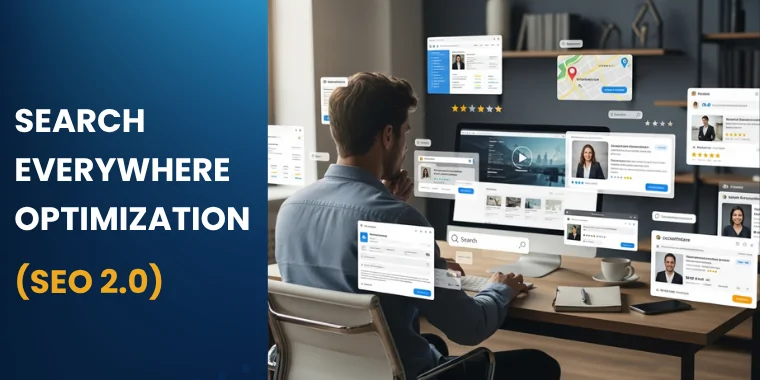
“Search is no longer just Google — it’s everywhere.”
For years, digital visibility was mostly about one thing: ranking on Google.
If your website showed up on page one for the right keywords, you were in a strong position to attract traffic, leads, and customers. That model still matters — but it’s no longer the full picture.
Today, people search everywhere.
They ask questions on Google, watch tutorials on YouTube, compare recommendations on Reddit, browse products on Amazon, check reviews on Google Maps, discover businesses on Instagram and TikTok, and increasingly turn to AI tools like ChatGPT, Gemini, and Perplexity for direct answers.
That shift has created a new reality for brands: if you want to be found, you need to be visible across the full search ecosystem — not just search engines.
That’s where Search Everywhere Optimization comes in.
What Is Search Everywhere Optimization?
Search Everywhere Optimization (SEO 2.0, if you will) is the practice of making your business, content, and products discoverable across every platform, algorithm, and search interface where your audience actively searches for answers.
It’s not about gaming one algorithm anymore. It’s about understanding the unique behaviors, formats, and requirements of dozens of different search environments—and optimizing for all of them simultaneously.
Think of it as shifting from a single-channel strategy to an omnidirectional presence. Your brand needs to be visible when customers search on:
- Google Search (traditional organic results)
- AI-powered assistants (ChatGPT, Claude, Gemini, Perplexity)
- Video platforms (YouTube, TikTok, Instagram Reels)
- Social networks (LinkedIn, Twitter/X, Reddit, Discord)
- Shopping platforms (Amazon, eBay, specialized marketplaces)
- Mapping services (Google Maps, Apple Maps, Waze)
- Voice assistants (Alexa, Siri, Google Assistant)
- Specialized search engines (GitHub for code, Spotify for music, etc.)
When customers are looking for you in any of these places, you need to be there—or lose the sale to a competitor who is.
Because the truth is, your next customer may not start with a Google search anymore.
They may ask:
- “Best accountant for small business in Toronto” in ChatGPT
- “Best coffee spots near me” on Google Maps
- “Best running shoes for beginners” on YouTube
- “Is this marketing agency worth it?” on Reddit
- “Top skincare brands” on TikTok
If your business only optimizes for one channel, you’re missing a growing share of modern search behavior.
Why SEO Alone Isn’t Enough Anymore?
To be clear: SEO still matters. Strong website optimization, technical performance, content quality, backlinks, and keyword targeting are all still essential.
But traditional SEO was built around an older assumption: that people search primarily on Google, click through to websites, and browse from there.
That assumption is changing.
Search today is more fragmented, more conversational, and more platform-specific than ever before.
People no longer just “Google it.” They:
- Ask AI tools for recommendations
- Search visually on YouTube and TikTok
- Trust peer opinions on Reddit and forums
- Use map apps to find local services
- Search directly inside marketplaces before buying
That means a business can have a decent website and still struggle to get discovered if it isn’t visible across the broader search landscape.
In other words: ranking well on Google is still valuable — but it’s no longer enough on its own.
The Framework: SEO vs. AEO vs. GEO
1. Traditional SEO (Search Engine Optimization)
This is what we’ve always known: optimizing for Google’s organic search results. It still matters—Google still drives significant traffic for many industries. But it’s now just one part of the puzzle.
Focus areas: Keywords, technical SEO, backlinks, content quality, site structure, Core Web Vitals all that stuff we’ve been doing for the past 20 years..
2. AEO (Answer Engine Optimization)
This is the new frontier. AEO means optimizing your content to be cited, referenced, or recommended by AI-powered assistants like ChatGPT, Claude, Gemini, and Perplexity.
When someone asks an AI “What’s the best project management tool for remote teams?”—your tool needs to appear in that answer. That requires a different approach than Google SEO. AI systems favor:
- Clear, factual, well-sourced information
- Expert credentials and authority
- Original data, research, and insights
- Structured data that’s easy for AI to parse and cite
- Being accessible to AI crawlers
3. GEO (Generalized Engine Optimization)
This extends beyond search to “everywhere optimization.” It includes YouTube optimization, social platform optimization, marketplace optimization, and any other platform where discovery happens through an algorithmic feed.
Each platform has unique rules:
- YouTube: Thumbnail quality, watch time, click-through rate, audience retention
- TikTok: Hook timing, trend relevance, completion rate, shares
- Amazon: Product titles, reviews, conversion rate, return rate
- Reddit: Authentic participation, community alignment, upvotes
- LinkedIn: Engagement rate, network effects, professional authority
Why Do Brands Need Visibility Across All Search Surfaces ?
The customer journey has become fragmented. Your ideal customer might discover you through five different channels before making a purchase decision.
Consider this realistic scenario:
- They see a video ad on TikTok that piques their interest
- They Google your company to learn more
- They ask ChatGPT for comparisons, and your product gets mentioned
- They check your reviews on Reddit and Trustpilot
- They find your product on Amazon and read the reviews there
- They visit your website to complete the purchase
Miss any of these touch points, and they might not complete the journey. If your competitor is visible everywhere and you’re only on Google, you lose.
More concerningly, different customer segments search differently:
- Gen Z and younger millennials start on TikTok or YouTube, not Google
- B2B decision makers may ask AI questions before searching traditionally
- Deal-conscious buyers check Amazon and specialized marketplaces first
- Enterprise buyers research on LinkedIn and industry forums
Visibility across all surfaces isn’t optional—it’s required to capture the full addressable market.
How Businesses Should Adapt?
So what does this mean for your strategy? Here’s how to start:
1. Audit Your Current Presence : Where are you discoverable today? Google, yes. But what about YouTube, Reddit, Amazon, AI assistants, LinkedIn, and TikTok? Map your visibility across all channels.
2. Prioritize by Audience : Where does your target customer actually search? Don’t waste effort on channels that don’t matter to them. If you sell B2B software, LinkedIn and Google matter more than TikTok. If you sell consumer products, TikTok and Amazon are critical.
3. Adapt Content for Each Platform : YouTube needs video. TikTok needs 15-60 second hooks. Reddit needs authentic engagement. AI assistants need clear, sourced data. Don’t repurpose the same content everywhere—create platform-native content.
4. Build Authority Signals Across Channels : AI assistants and newer algorithms prioritize brands that demonstrate authority, expertise, and trustworthiness across multiple platforms. Earn reviews, get cited, build communities.
5. Measure What Matters : Don’t just track Google rankings anymore. Track visibility, mentions, and conversion sources across YouTube, TikTok, Amazon, Reddit, Google, Maps, and any other channel relevant to your business.
The Future of Search Is Everywhere
Search is no longer confined to a single search bar.
Your audience is moving across platforms, devices, and AI-powered tools to find answers, compare options, and make decisions faster than ever before. Learn more about How to Optimize Your Website for AEO
That means digital visibility can no longer be treated as “just SEO.” It needs to be broader, more adaptable, and more aligned with how people actually search today. That’s exactly what Search Everywhere Optimization is about.
It’s not the end of SEO — it’s the evolution of it.
And for businesses that want to stay visible, relevant, and competitive, that evolution matters.
Want to Improve Your Search Visibility?
Implementing this across multiple platforms is complex. You need a team that understands each platform’s unique algorithm, knows what actually drives ROI, and can work with you long-term to refine the strategy.
Book Your Free Consultation and let’s talk about where your competitors are winning and how we can flip that around. Or if you prefer to chat first, call us at 437-826-9333 – we’re happy to discuss your specific situation and what a Search Everywhere strategy could look like for your business.
The future of search visibility is here. Let’s make sure you’re not left behind.


