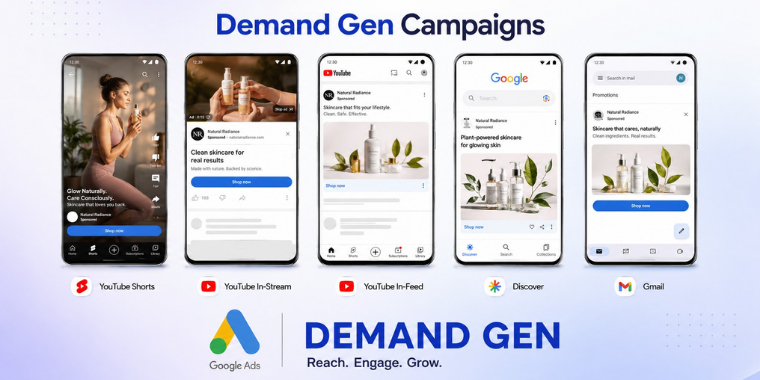
If you have been running Google Ads for a while, you have probably heard the buzz around Demand Gen campaigns. But what exactly are they, and are they actually worth your ad budget? Short answer: yes, especially if you want to reach people before they start actively searching for what you sell.
Let’s break it all down.
What Is a Demand Gen Campaign?
Demand Gen (short for Demand Generation) is a Google Ads campaign type designed to help you reach new audiences and spark interest in your product or service before a user even knows they need it.
Unlike Search campaigns that capture existing demand, Demand Gen campaigns are built to create demand. They put your brand in front of the right people at the right moment using Google’s most visually engaging placements:
- YouTube (in-stream, in-feed, and Shorts ads)
- Gmail (Promotions and Social tabs)
- Google Discover feed (on mobile and the Google app)
Think of it this way: Search campaigns fish where people are already looking. Demand Gen campaigns cast the net before they even pick up a fishing rod.
Demand Gen replaced the older Smart Display and Discovery campaigns in 2023, bringing more creative control, better audience targeting, and stronger performance signals into one streamlined campaign type.
Who Should Use Demand Gen Campaigns?
Demand Gen works especially well for:
- E-commerce brands wanting to drive product discovery and retarget past visitors
- B2B companies looking to build brand awareness earlier in the buying journey
- Service-based businesses targeting users who do not know a solution like theirs exists
- Businesses with strong visual creative (video, lifestyle images, product photos)
If your product has a longer consideration cycle or you rely on impulse-driven purchases, Demand Gen is built for exactly that buying behaviour.
Key Features That Make Demand Gen Stand Out
1. Multi-Format Creative in One Campaign
You can run images, videos, and carousels all from the same campaign. Google automatically tests and serves the best-performing format to each user depending on their placement and behaviour.
- Upload horizontal, square, and vertical video assets
- Add carousel image ads for product-focused creatives
- Mix static images with video for maximum placement coverage
2. Lookalike Audiences
This is one of Demand Gen’s most powerful features. You can upload a customer list and Google will find new users who behave similarly to your existing customers.
- Upload email lists or CRM data as seed audiences
- Google matches patterns in behaviour, interests, and intent
- Reach people who have never heard of you but are highly likely to convert
Highlighted Feature: Lookalike segments in Demand Gen give you prospecting power that was previously only available on Meta. It is a game-changer for brands trying to scale beyond their existing audience.
3. Visual-First, Immersive Placements
Demand Gen lives in Google’s most visual environments. YouTube Shorts alone reaches over 2 billion logged-in users monthly. That kind of scale with precise audience targeting is hard to match anywhere else.
- YouTube Shorts for short-form vertical video (up to 60 seconds)
- In-feed YouTube ads that appear alongside organic content
- Discover feed ads that look native, not disruptive
- Gmail ads that appear as expandable messages in the inbox
4. Optimised Targeting with Google AI
Rather than manually layering dozens of targeting signals, Demand Gen uses Google’s AI to find the right users automatically. You guide it with:
- Custom audiences (based on interests, URLs, or apps)
- Life events and in-market segments
- Your own first-party data via customer match
How Demand Gen Campaigns Fit Into Your Funnel?
Here is where most businesses get confused. Demand Gen is not a direct replacement for your Search campaigns. It works best as a top-of-funnel and mid-funnel tool that feeds your broader Google Ads strategy.
A smart funnel setup looks like this:
- Demand Gen: Build awareness and reach new audiences on YouTube, Gmail, Discover, and Shorts
- Search Ads: Capture high-intent users actively searching for your products or services
- Performance Max: Expand reach across Google channels and automatically retarget engaged users to maximize conversions
- Retargeting: Re-engage previous visitors and users who interacted with your business but did not convert (through PMax or dedicated campaigns)
Running Demand Gen alongside Search campaigns often results in higher overall conversion rates because more people already know your brand before they search for it.
Demand Gen vs. Performance Max vs Search Ads
This is a question that comes up a lot. Here is a simple breakdown:
| Feature | Demand Gen | Performance Max (PMax) | Search Ads |
|---|---|---|---|
| Goal | Create demand | Maximize conversions | Capture existing demand |
| Audience Intent | Low–Medium | Medium–High | High |
| Targeting | Audiences & interests | AI + audience signals | Keywords |
| Placements | YouTube, Discover, Gmail, Shorts | All Google channels | Google Search only |
| Control Level | Medium | Low | High |
| Automation | High | Very High | Medium |
| Best For | Brand awareness & prospecting | Scaling leads/sales | High-intent leads |
| Lead Quality | Moderate | Good | Highest |
| Budget Need | Medium–High | Medium–High | Small–Large |
| Main Strength | Reach new audiences | Broad AI optimization | Precise targeting |
| Main Limitation | Lower buying intent | Less transparency | Limited reach |
All three campaign types can work together: Demand Gen creates awareness, Search Ads capture active intent, and Performance Max expands and maximizes conversions across Google’s channels.
Best Practices to Get the Most From Demand Gen
- Invest in creative quality: Demand Gen is a visual format. Blurry images and low-production video will not cut it. Your creativity is your target.
- Use at least 3-5 creative variations: Give Google’s AI enough to test and optimise.
- Set realistic expectations: Demand Gen is not a Day 1 conversion machine. Give it 2-4 weeks of learning before drawing conclusions.
- Layer in your first-party data: Customer match lists improve targeting accuracy significantly.
- Monitor view-through conversions carefully: Not every metric will be a direct click. Brand lift and assisted conversions matter here too.
Pro Tip: Pair Demand Gen with a strong retargeting strategy. Someone who watched 75% of your YouTube ad and then visited your site is a hot lead. Make sure your retargeting campaigns are ready to catch them.
Why Demand Gen Is the Future of Google Advertising?
The way people discover brands has fundamentally changed. They scroll feeds, watch short videos, and read content passively before they ever type a search query. Demand Gen meets potential customers in those moments, building familiarity and trust before the competition even enters the picture.
Google built Demand Gen for a world where attention is the new click. If your competitors are only running Search ads and you are running Demand Gen too, you are playing a completely different game.
Thinking About Running Demand Gen Ads for Your Business?
Demand Gen campaigns can be genuinely exciting, but they also come with a learning curve. Getting the creative right, building the right audiences, and connecting it all to a funnel that actually converts takes more than just switching the campaign on.
That is where having the right team makes a real difference.
Pat’s Marketing is a certified Google Partner and a trusted name in PPC marketing in Toronto, with over 15 years of hands-on experience managing Google Ads for small and medium businesses. No contracts, no fluff — just honest advice and campaigns that are built to perform.
Book a free consultation or call 1.888.488.7287 to get started.