If you’ve been running a business in the GTA for any length of time, you know that standing still is the fastest way to fall behind. The search landscape isn’t just shifting; it’s evolving into something entirely new.
In 2026, the days of keyword stuffing and buying cheap backlinks are dead. Today, Google’s algorithms—powered by increasingly sophisticated AI—are looking for genuine authority, user satisfaction, and technical precision. For Toronto business owners, this means the bar is higher.
With over 15 years of experience navigating these shifts, we have seen firsthand that sustainable rankings come from adapting to the algorithm, not fighting it. Whether you are running a dental practice in North York or a construction firm in Mississauga, understanding where search is heading is the only way to protect your digital revenue.
Here are the top 15 SEO ranking factors that will define success in 2026 and beyond.
1. Helpful Content with “Experience” (E-E-A-T)
Google has been prioritizing E-A-T (Expertise, Authoritativeness, and Trustworthiness) for years. However, the addition of “Experience” is the game-changer for 2026. Search engines can now easily distinguish between generic, AI-scraped text and content written by someone who has actually done the work.
To rank, your content must demonstrate first-hand knowledge. If you are a plumber, don’t just explain how to fix a drain; explain the specific challenges of fixing drains in older Toronto homes. Authentic, experience-driven insights are the strongest defense against generic AI answers.
2. Topical Authority Over Keywords
Ranking for a single “money keyword” is becoming harder if your site lacks depth. Google looks for “Topical Authority,” which means your website should cover a subject comprehensively.
Instead of writing one giant page about “Renovations,” you need a cluster of interlinked pages covering every angle—costs, permits in Ontario, materials, and timelines. This signal tells search engines that you are the go-to resource in your niche, lifting the rankings of your entire site.
3. User Engagement Signals (Behavioral Metrics)
Google denies using Google Analytics data for ranking, but they absolutely track how users interact with search results.
- Dwell Time: Do users stay on your page or bounce back immediately?
- Click-Through Rate (CTR): Is your title tag compelling enough to get the click?
- Scroll Depth: Are users actually reading your content?
If users consistently leave your site seconds after arriving, it signals to Google that your result was irrelevant, and your rankings will drop.
4. Search Intent and AI Overviews
With the rise of AI-integrated search (like Google’s Search Generative Experience), matching search intent is non-negotiable. Users are searching differently—using natural language and expecting immediate answers.
Your content needs to align exactly with what the user wants. Are they looking to buy right now (Transactional), or are they just researching (Informational)? If you try to sell to someone who just wants a definition, or give a definition to someone trying to buy, you will lose the ranking.
5. Local Proximity and Entity Verification
For any business relying on local foot traffic or service areas, proximity remains king. However, 2026 brings a stricter focus on “Entity Verification.” Google wants to know you are a real business located where you say you are.
This involves more than just a Google Business Profile. It requires consistent NAP (Name, Address, Phone) data across the web, local citations, and localized content that proves your connection to the Toronto community.
6. Mobile-First Experience
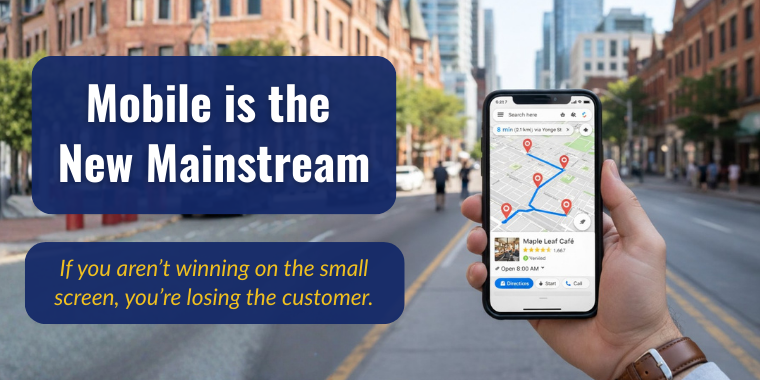
“Mobile-friendly” is old news. We are now in a “Mobile-Only” reality. Google predominantly uses the mobile version of your content for indexing and ranking.
If your site is difficult to navigate on a phone, or if pop-ups block the main content on a small screen, you will be penalized. This is often where a technical SEO audit reveals the biggest opportunities for growth, as many business owners still review their sites primarily on desktop computers.
7. Core Web Vitals – LCP, CLS and INP
Page speed still matters, but Google’s Core Web Vitals now emphasize real user experience. In 2026, the key metric to watch is INP (Interaction to Next Paint).
INP measures how quickly a page responds after a user clicks, taps, or interacts with it. A site can load fast yet still feel slow if interactions are delayed—and that hurts rankings.
While LCP focuses on load speed and CLS ensures visual stability, INP reflects how usable a page feels. Improving it often requires clean code, optimized JavaScript, and reliable hosting.
Fast pages must also feel instant. That’s the difference-maker in modern SEO.
8. Backlink Relevance (Quality Over Quantity)
The era of blasting your site with thousands of low-quality directory links is over. In fact, that strategy is now toxic.
Google’s AI is incredibly good at understanding the relationship between websites. A single link from a relevant, high-authority trade association or a local Toronto news outlet is worth more than 100 links from unrelated blogs. Your off-page strategy must focus on earning links that make sense for your industry.
9. Structured Data and Schema Markup
Schema markup is the code that helps search engines understand the context of your content. It’s how you tell Google, “This is a recipe,” “This is a review,” or “This is a service we offer.”
As search becomes more automated, giving search engines this data in a clean, structured format is essential. It also increases the likelihood of your site appearing in Rich Snippets (the detailed boxes at the top of search results), which drastically improves click-through rates.
10. Brand Authority and “Linkless” Mentions
Google is moving toward treating brands as entities. This means that even if a website mentions your brand name without hyperlinking to you, it still counts as a trust signal.
Building a brand that people talk about—on social media, in forums, and in reviews—is becoming a direct SEO factor. This holistic approach is why we often integrate PR and reputation management into our broader SEO strategies.
11. Content Freshness and Lifecycle Management
Content decay is real. A blog post from 2021 with outdated statistics or broken links acts as an anchor dragging down your site’s performance.
To maintain rankings in 2026, you must regularly audit and update existing content. Adding new information, updated dates, and current market context signals to Google that your site is alive and well-maintained.
12. Internal Linking Structure
Internal links are the highways search spiders use to travel through your website. A strategic internal linking structure passes authority from your high-performing pages to your newer service pages.
If you have a strong blog post about “Winter Roofing Maintenance,” it should naturally link to your “Roof Repair Services” page. This keeps users on the site longer and helps Google index your deep pages faster.
13. Video and Visual Search Optimization
Video consumption continues to skyrocket. Google often ranks YouTube videos at the top of search results for “How-to” queries.
Optimizing your images and including video content with proper transcripts and metadata is no longer optional. It allows you to capture traffic from Google Images and the video carousel, broadening your visibility beyond standard text results.
14. Trust and Security (HTTPS)
This is a baseline requirement. If your site triggers a “Not Secure” warning, you have already lost the user (and the ranking). Beyond basic SSL certificates, Google looks for secure forms and privacy policy compliance. Users need to feel safe handing over their data.
15. CTR from Search Results
In 2026, click-through rate (CTR) from search results plays a stronger role in how Google evaluates content relevance and user satisfaction. When users consistently choose one result over others, it signals that the page’s title tag, meta description, URL structure, and rich results better match search intent. Pages with compelling, accurate snippets earn higher engagement, while misleading or weak listings lose visibility over time. Optimizing for CTR now requires aligning messaging with intent, improving SERP appearance, and delivering on the promise once users click—making CTR a critical bridge between on-page SEO and real user behavior.
Adapting Your Strategy for the Future
The list above might seem extensive, but it boils down to one core philosophy: Google wants to reward businesses that provide the best possible experience for the user.
Many agencies try to “trick” the system with short-term hacks. With over 350 happy clients and an approach grounded in data and longevity, we know that true SEO success comes from building a solid foundation. You need a partner who understands the nuance of the Toronto market and utilizes AI-driven strategies to keep you ahead of the curve.
If your traffic has plateaued or you are tired of guessing what works, it is time to get a strategy built for 2026, not 2016.
Contact Pat’s Marketing, Toronto’s trusted SEO expert. Call us today at 437-826-9333.
Let’s discuss how to improve your market share.