In the ever-evolving landscape of Toronto’s digital marketplace, the way customers find your business has shifted. Gone are the days of just “ranking for a word.” Today, search engines like Google prioritize user intent—understanding not just what someone typed, but why they typed it.
For a local business owner in the GTA, the difference between a high-traffic keyword and a high-conversion keyword can be the difference between a busy phone line and a quiet office. To win in 2026, you need a balanced diet of short-tail and long-tail keywords.
The Fundamentals: Breaking Down the Terms
Before we dive into the strategy, let’s define the players. Think of your keyword strategy like a fishing net: some parts are designed to catch anything that swims, while others are designed for a specific prize.
1. Short-Tail Keywords (The “Broad” Terms)
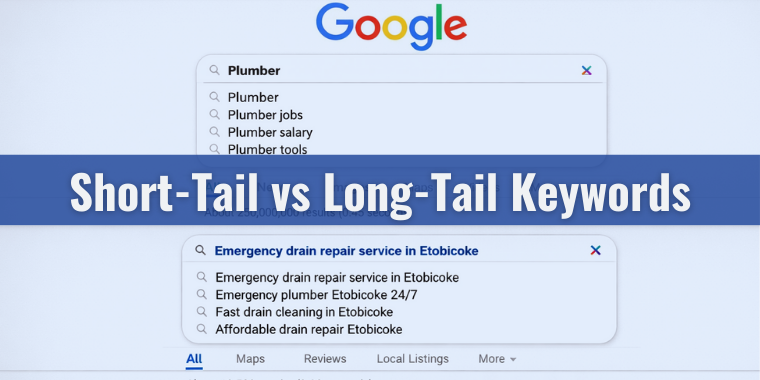
Short-tail keywords are typically one or two words. They are broad, high-volume, and incredibly competitive.
- Example: “Plumber” or “Real Estate.”
- The Pro: Massive search volume.
- The Con: Low conversion rates because the intent is vague. Someone searching “Plumber” might be looking for a job, a definition, or a DIY video—not necessarily a service provider in North York.
2. Long-Tail Keywords (The “Specific” Phrases)
Long-tail keywords are longer, more descriptive phrases (usually 3+ words).
- Example: “Emergency drain repair in Etobicoke” or “Best SEO agency in Toronto for small business.”
- The Pro: High conversion rates. When someone is this specific, they are usually ready to buy or book.
- The Con: Lower search volume per individual phrase.
Why Toronto Businesses Need Both?
If you only target short-tail keywords, you’ll likely find yourself buried under massive national brands with million-dollar budgets. If you only target long-tail, you might miss out on the broader “top-of-funnel” awareness that builds your brand over time.
At Pat’s Marketing, we’ve spent over 15 years helping more than 350 clients navigate this balance. We’ve seen that the most successful Toronto SEO strategies use a “Hub and Spoke” model.
The “Hub and Spoke” Strategy
- The Hub (Short-Tail): Your main service pages target broader terms like “SEO services in Toronto.”
- The Spoke (Long-Tail): Your blog posts and sub-pages target specific questions your customers are asking, such as “How to improve local search rankings for a Mississauga law firm.”
By answering specific questions, you build authority. Google sees that you are an expert in the “long-tail” nuances, which eventually helps your “short-tail” service pages rank higher.
2026 Trends: Intent Over Volume
With the rise of AI-driven search and voice commands, people are searching more naturally. They don’t just type keywords; they ask questions.
When we develop AI-driven SEO strategies, we look beyond the “monthly search volume” metric. We look at the searcher’s intent. Intent generally falls into three categories:
- Informational: “What is a long-tail keyword?”
- Navigational: “Pat’s Marketing contact page.”
- Transactional: “Hire an SEO agency in Toronto.”
For a local service business, the gold mine is Transactional Long-Tail. These are the phrases used by people who have a problem right now and are looking for a local solution in the GTA.
Actionable Steps for Your Business
How can you apply this to your website today? Follow this simple framework:
- Identify Your Core Pillars: List your 3-5 main services. These are your short-tail targets.
- Listen to Your Customers: What are the top 10 questions your clients ask on the phone? Each of those questions is a long-tail keyword phrase for a blog post.
- Localize Everything: Don’t just say “Accounting Services.” Say “Tax preparation for tech startups in Downtown Toronto.” This reduces competition and increases relevance.
- Analyze the Results: Don’t just track rankings; track conversions. A keyword that brings 10 people to your site who all call you is worth more than a keyword that brings 1,000 people who leave immediately.
Building a Sustainable Strategy
SEO is no longer about “tricking” an algorithm. It’s about providing the most relevant answer to a user’s problem. Whether you are a boutique law firm in Yorkville or a landscaping company in Scarborough, your digital visibility depends on being found at every stage of the customer journey—from the broad “how-to” searches to the specific “hire now” requests.
Navigating the complexities of modern, AI-integrated SEO can be a full-time job. If you’d rather focus on running your business while experts handle your digital growth, we’re here to help.
Ready to see how a tailored keyword strategy can grow your revenue?
Reach out to the team at Pat’s Marketing, Toronto’s trusted SEO experts. Call us at 437-826-9333 for a transparent, no-nonsense assessment of your current SEO.