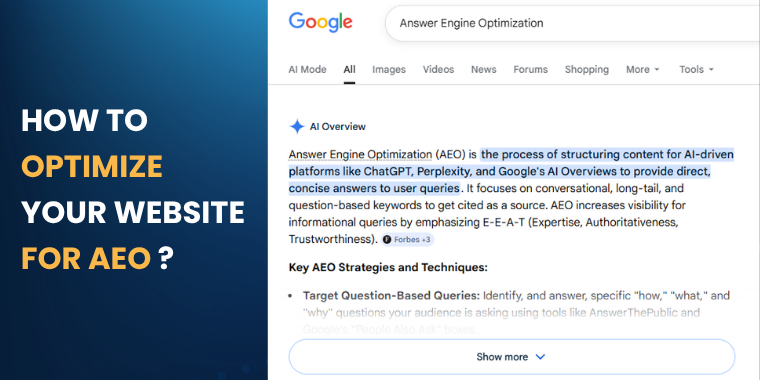
Search is no longer just about ranking on page one. Today, your customers are asking questions — and expecting instant, direct answers. If your website isn’t built for Answer Engine Optimization (AEO), you’re invisible to a growing share of searches.
As AI-powered search tools like ChatGPT, Google’s AI Overview, and Perplexity reshape how people find information, a new frontier in digital marketing has emerged: Answer Engine Optimization (AEO). While traditional SEO focuses on ranking in search engines, AEO is about earning visibility in AI-powered answer engines that synthesize information and generate direct answers.
The shift matters because user behavior is changing rapidly. When an AI assistant cites your content, it brings qualified visitors with high intent. Answer engines drive real traffic, and 40% of Gen Z now prefer AI search tools over traditional engines. As more queries get answered directly by AI, the opportunity to capture visibility in this channel is critical.
What Is AEO, and How Is It Different from SEO?
SEO (Search Engine Optimization) focuses on getting your website to rank higher in traditional search results. AEO (Answer Engine Optimization) takes a step further — it’s about positioning your content as the direct answer to a user’s question, whether that’s in a featured snippet, a voice assistant response, a knowledge panel, or an AI-generated summary.
Where SEO prioritizes rankings and traffic, AEO prioritizes authority and trust. When Google, Siri, or an AI chatbot reads your content aloud as the answer to a question, that’s AEO in action. The good news? The two strategies are deeply complementary. A well-executed SEO services in Toronto strategy that incorporates AEO thinking will outperform one that doesn’t — period.
At Pat’s Marketing, we help brands optimize for this new reality. Here’s how to ensure your content gets in front of millions of people using AI search tools.
1. Research Conversational and Question-Based Keywords
The starting point for any AEO strategy is understanding how real people phrase their questions. Unlike traditional keyword research, which focuses on short phrases like “best coffee Toronto,” AEO research looks for natural, spoken-style queries like “where can I find the best independent coffee shop in downtown Toronto?”
Tools like AnswerThePublic, Google’s People Also Ask section, and SEMrush’s question filters are excellent starting points. Group these queries by intent — informational, navigational, transactional — and build content that speaks directly to each type.
Pro Tip : Go through your customer support emails and FAQs. The exact questions your customers are typing to you are often the same ones they’re asking Google. These are goldmines for AEO content.
2. Build E-E-A-T Signals
Answer engines prioritize content quality through Google’s E-E-A-T framework: Experience, Expertise, Authoritativeness, and Trustworthiness.
- Experience: Include personal insights, case studies, and real-world examples. AI engines favor content from people who’ve actually done the work.
- Expertise: Establish credentials with author bios that highlight relevant experience and certifications. Use natural language rather than keyword stuffing—write about “marketing firms” and “digital agencies” rather than repeating the same phrase.
- Authoritativeness: Earn backlinks from reputable sources. Guest posts, interviews, and partnerships all signal authority to answer engines.
- Trustworthiness: Be transparent about sources, cite data properly, and keep content factually accurate. Include disclaimers where appropriate.
3. Structure Your Content for Direct Answers
Answer engines reward content that is clear, concise, and structured. If you want to win a featured snippet or appear in an AI answer, your page needs to deliver the answer quickly — ideally within the first 40 to 60 words of addressing the question.
Here’s the format that consistently performs well:
- Start with the question as your heading (H2 or H3)
- Follow immediately with a clear, 2–3 sentence answer
- Expand with supporting detail, examples, or steps below
- Use bullet points or numbered lists wherever possible
- Keep paragraphs short — three to four lines maximum
This pattern tells both search engines and AI systems that your page is a reliable, well-organized source of factual information.
4. Build Topical Authority — Not Just Individual Pages
Answer engines favor websites that demonstrate deep expertise in specific topics. Build topical clusters rather than scattered content.
- Create pillar content: Write comprehensive guides (2,000+ words) covering your core topic broadly.
- Create cluster content: Write focused articles (1,500+ words) addressing specific subtopics.
- Interlink strategically: Link from cluster content to pillar content and between related articles. This shows answer engines your site is a comprehensive resource.
For a B2B software company, this might look like: Pillar—”Complete Guide to Project Management Software,” with clusters like “Best PM software for remote teams,” “Agile vs Waterfall project management,” etc.
5. Optimize for Voice Search
Voice search is one of the fastest-growing drivers of AEO. When someone asks Alexa, Google Home, or Siri a question, the device reads one answer aloud — and that answer almost always comes from a featured snippet or a locally optimized business listing. If you’re not targeting voice, you’re leaving a significant channel untouched.
Voice optimization strategies include writing in a conversational tone, targeting question-and-answer formats, optimizing your Google Business Profile with accurate and detailed information, and ensuring your site loads quickly on mobile devices.
People using answer engines ask questions conversationally, the way they’d ask a friend. Your content should match this natural language.
- Anticipate follow-up questions. If someone asks “What is AEO?” they’ll likely follow with “How is it different from SEO?” Answer these proactively.
- Use natural language. Write as though explaining something to a colleague.
- Include FAQ sections. Dedicated FAQ sections are goldmines for answer engine optimization—structure them with questions and short, direct answers.
6. Build Authority Through Quality Backlinks
Answer engines reference sources that other authoritative sites link to. A strong backlink profile signals trustworthiness to AI systems.
- Guest post on industry publications targeting sites with strong authority in your niche.
- Create linkable assets like original research, tools, and comprehensive guides that naturally attract backlinks.
- Build relationships with journalists, bloggers, and industry influencers.
- Earn brand mentions—even without links, brand mentions signal authority to answer engines.
7. Keep Content Fresh and Accurate
Answer engines prioritize current, accurate information. Outdated content is less likely to be cited.
- Review and update regularly. Audit top-performing content quarterly. Update statistics, examples, and information that’s become outdated.
- Add dates. Include both publication and last update dates so answer engines know how current your content is.
- Correct errors promptly. Fix inaccuracies immediately.
- Monitor citations. Track which of your pages get cited by AI engines to identify what performs well.
8. Tailor Content to Query Types
Different query types require different content structures.
- Fact queries (“What is the capital of France?”): Provide a direct, factual answer upfront with supporting context.
- How-to queries (“How do I change a tire?”): Use step-by-step formatting with numbered steps and clear instructions.
- Comparison queries (“Agile vs Waterfall”): Create side-by-side comparisons in tables, remaining fair and balanced.
- Opinion/advice queries (“Best practices for remote teams”): Draw on expertise and examples, and acknowledge different perspectives.
9. Use Multimedia Strategically
While text is foundational, multimedia strengthens your AEO efforts.
- Videos: Answer engines cite and embed videos that directly answer common questions.
- Infographics: Visual representations with descriptive alt text are more likely to be cited.
- Tables and charts: Structured data visualizations help answer engines understand comparisons and trends quickly.
10. Build Brand Authority
Answer engines consider brand authority and reputation. A strong brand signal indicates trustworthiness.
- Develop a distinctive voice with consistent, recognizable writing style.
- Create original insights through unique research, frameworks, and perspectives.
- Be active on social media to build brand authority and help your content reach answer engine crawlers.
- Encourage reviews and testimonials to strengthen trustworthiness signals.
The Future of Search is Here
Answer Engine Optimization isn’t a future trend—it’s happening now. Brands optimizing for answer engines today will have a competitive advantage tomorrow. The good news is that many AEO best practices align with good content marketing and traditional SEO, so your efforts compound across channels.
Start by auditing your existing content against the principles in this guide. Identify your strongest topical areas and deepen your expertise. Create comprehensive, well-structured content that directly answers user questions. Build authority through quality backlinks and consistent brand development.
The winners in this new digital landscape won’t be those chasing the latest algorithm. They’ll be the ones building genuine expertise, creating valuable content, and earning trust from both users and machines.
Ready to Optimize your Website for Answer Engines?
At Pat’s Marketing, we help brands build strategies that win across search, social, and AI-powered discovery channels.
📞 Call 1-888-488-7287 to speak with a Toronto SEO consultant today. Let’s talk about how to position your business for the future of search.